
Airbnb host entry planning · Toronto & GTA
Self check-in. With someone responsible behind it.
A guest arriving independently still needs clear instructions and a host who owns the access process. Compare that whole experience when searching for an Airbnb smart lock.
Check the promised arrival experience
Explain what a first-time guest should be able to do.
Compare it against the proposed credential and entrance route. An assessment helps establish what can actually be promised to a guest.
Set the host responsibilities
Separate reservation decisions from manually issued door access.
Review guest contingencies
Check the actual lock and a failed-arrival procedure.
Confirm the handover requirements
Agree key limits, turnover administration and continuing costs.
In short
Does an Airbnb smart-lock search imply a platform connection?
Distinguish host-managed access from booking automation
No. Search results include many manufacturers and integrations. SmartphoneKey documents timed guest keys, but the available evidence does not confirm an automatic Airbnb connection. A host can evaluate those credentials while retaining responsibility for matching the right permission to each approved stay.
Example, not a completed project
A useful arrival message starts before the front door.
Imagine a guest reaching an accommodation building for the first time. The message needs to identify the correct approach, any separate lobby arrangement, the credential expected at the unit and the person to contact if the route does not work as described. If two openings have different management or equipment, a successful demonstration at the unit does not answer the lobby question. The host also needs an agreed process for a changed stay; the presence of a guest expiry setting does not prove that a platform update changes it. This is an illustrative communication exercise, not a sent guest message, a completed installation or evidence of an automatic Airbnb connection.
Write the message and verify the promise
Describe the real guest route without inventing an integration.
Treat the proposed instructions as something to check against the assessed opening and configured permission. Keep the host's operational decisions distinct from what the product has actually documented.
Make the arrival understandable
- Describe how the guest identifies the intended entrance and any earlier common door. Avoid a generic statement that a phone opens the property when only one part of the route has been assessed. Explain the responsible contact for an unresolved building-entry question before describing the whole journey as settled.
- State the credential method actually proposed and how the guest is expected to present it. A keypad code, supported phone key and visitor call are different arrangements. The wording should not imply that a feature from another manufacturer's product is part of this installation.
- Give the approved start and end of the stay their own administration process. The host needs to know who updates permission if those times change. An extension or cancellation being recorded on a booking platform is not proof that the reader configuration received the same change.
- Identify how the guest obtains assistance when the expected credential or arrival circumstances are unsuitable. A reader demonstration cannot promise a staffed response or a universal fallback. Agree the actual arrangement for this property and explain the limits clearly.
Check what the proposal establishes
- Ask the installer to identify equipment retained, equipment added and the physical work at each included opening. Keep supply, cabling and connection requirements visible. The search phrase Airbnb smart lock is not a technical specification for an unknown door or a promise that no alteration is needed.
- Name any requested platform behavior precisely: which permission should change, when it should change and who is expected to perform it. Keep that requirement separate until the proposed connection has been verified. Documented timed keys can be evaluated without treating synchronization as already included.
- Include the host or property manager who will maintain access in an authorized handover. Review the agreed arrival, a changed stay and the planned withdrawal, along with separate cleaner or contractor visits. An entry record is not proof of physical checkout or a completed turnover.
- Keep the accepted route, operating instructions, assistance contact and recurring charges available to somebody taking over management. Include untested devices, integration questions or excluded openings. The next host should not have to reconstruct the property's arrangement from a listing phrase or a product photograph.
Design the guest experience
Write the instructions before choosing the device.
Imagine a first-time guest reading the arrival message away from home. The description should match what the installed entrance actually supports.
01Identify the complete route
Explain how to find the property, the correct opening and any separate common entrance. A guest who reaches the lobby may still need a different permission for the unit. Confirm management authority over each proposed door before promising a single credential for the whole journey.
02Describe the actual credential
State the supported way the guest will receive and present permission, along with its agreed start and end. Avoid copying a keypad-code promise from another product. Ask how the visitor gets help if their phone or arrival circumstances do not fit the expected route.
03Assign changes to a person
A delayed departure, an extended stay or a cancelled booking needs an owner for the access change. A credential's expiry is useful, but it does not prove the platform and door system exchange updates. Include cleaner and contractor permissions in the same host checklist.
SmartphoneKey materials document timed guest permissions. The host communication examples explain how to evaluate that capability; they do not establish Airbnb endorsement, a booking synchronization or compatibility with an unrelated smart-lock product.


Match the description to the installed entrance
Review the hardware before writing the final arrival promise.
Ask the assessor to identify the current release, frame, supply and proposed connection and cable route. Explain any separately controlled building door and who can approve work there. The reader is part of an installed arrangement, not evidence that every smart-lock feature in an Airbnb-related search is included. Once the scope is understood, the host can compare the intended arrival wording with the supported credential, visitor assistance and actual openings. Keep an unverified platform relationship out of the installation promise.
Is it the right fit?
Does the intended arrival description match the proposal?
The host can explain the supported route
- You can manage access manually for each approved reservation.
- You want to assess a phone-based alternative to shared physical keys.
- The actual entry route can be explained to guests before arrival.
Resolve the unverified promise first
- Your purchase depends on an unverified Airbnb integration.
- You need unconfirmed compatibility with a named consumer-lock brand.
What can be promised to a guest?
Keep the listing language and the physical route consistent.
A clear message is based on the proposed entrance and supported credential. Explain the host's assistance route and retain any unverified feature as a question, rather than borrowing instructions from another product.
Is SmartphoneKey endorsed by Airbnb?
No endorsement or partnership is established here. This page addresses the host's use case. The booking platform name does not prove a product relationship or an automatic connection.
Can the same guest key remain active between unrelated stays?
Consider a separate permission for each authorized visit. Reusing unrestricted access makes it harder to know which stay it belongs to and when that permission should end.
How should a booking extension be handled?
The host needs to confirm the change and update the intended access period through the appropriate process. Do not assume a calendar edit elsewhere changes the door unless that exact connection has been verified.
Will an entry event prove the guest has checked out?
It records a door interaction, not a complete occupancy status. Confirm departures through the host's own process rather than treating the access log as a room sensor or proof that belongings have been removed.
What needs assessing at a condominium rental?
Separate the unit door from any shared lobby and check who may authorize work on each. A unit owner's hosting plan does not automatically grant authority to modify the building entrance.
Should a guest message show the actual entrance or a product illustration?
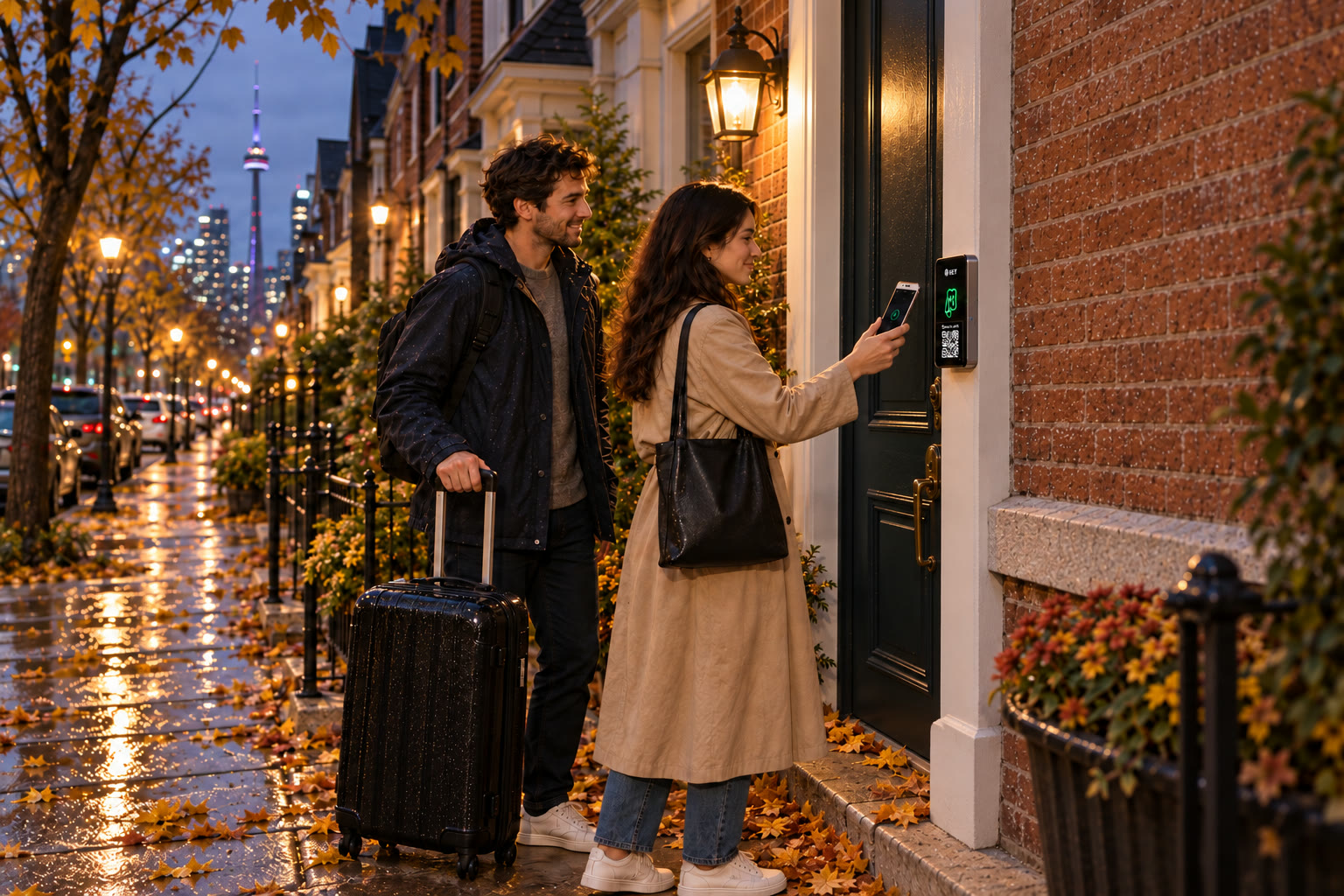
The guest needs instructions that match the property they will reach. A product visual can explain the reader concept but does not identify the correct building door, installed equipment or any separate lobby arrangement. Once the actual scope is established, check the arrival description against that route. Do not present an illustrative scene from this website as a photograph of the guest's accommodation or as proof that a particular opening has been installed.
How should two people helping manage a stay coordinate access changes?
Agree who authorizes the revised arrangement, who performs the permission change and how they confirm what remains outstanding. A booking notification reaching several people does not establish that the intended guest key was updated. Include the supported administration roles in the handover and keep the approved openings and period clear. The operating plan should not depend on somebody assuming the other host already completed a change.
What should be checked before describing self check-in as ready?
Review the complete approved arrival route, the credential the intended guest can use, its agreed permission and the actual assistance arrangement. Retain a separate question for an unresolved common entrance, untested device or required platform connection. A successful demonstration by the installer at one door does not establish every part of an unfamiliar guest's arrival. This preview provides no booking, invitation, rental approval or installation acceptance.
Next step
Bring the arrival message you want to send.
Compare it against the proposed credential and entrance route. An assessment helps establish what can actually be promised to a guest.
Request a door checkCompare the entrance scope with the message you intend to send
Include physical work, retained hardware, connection choice, credential setup and the host's administration handover. State continuing package charges and any unverified platform or device requirement separately. The final arrangement should explain which openings and operations have actually been assessed rather than relying on a familiar category name.
For a Toronto or GTA assessment, coordinate the host and any building contact needed to explain and approve the route. Discuss occupied periods and relevant service-area access before timing is proposed. This local preview neither reserves installation nor sends arrival instructions to a guest.