
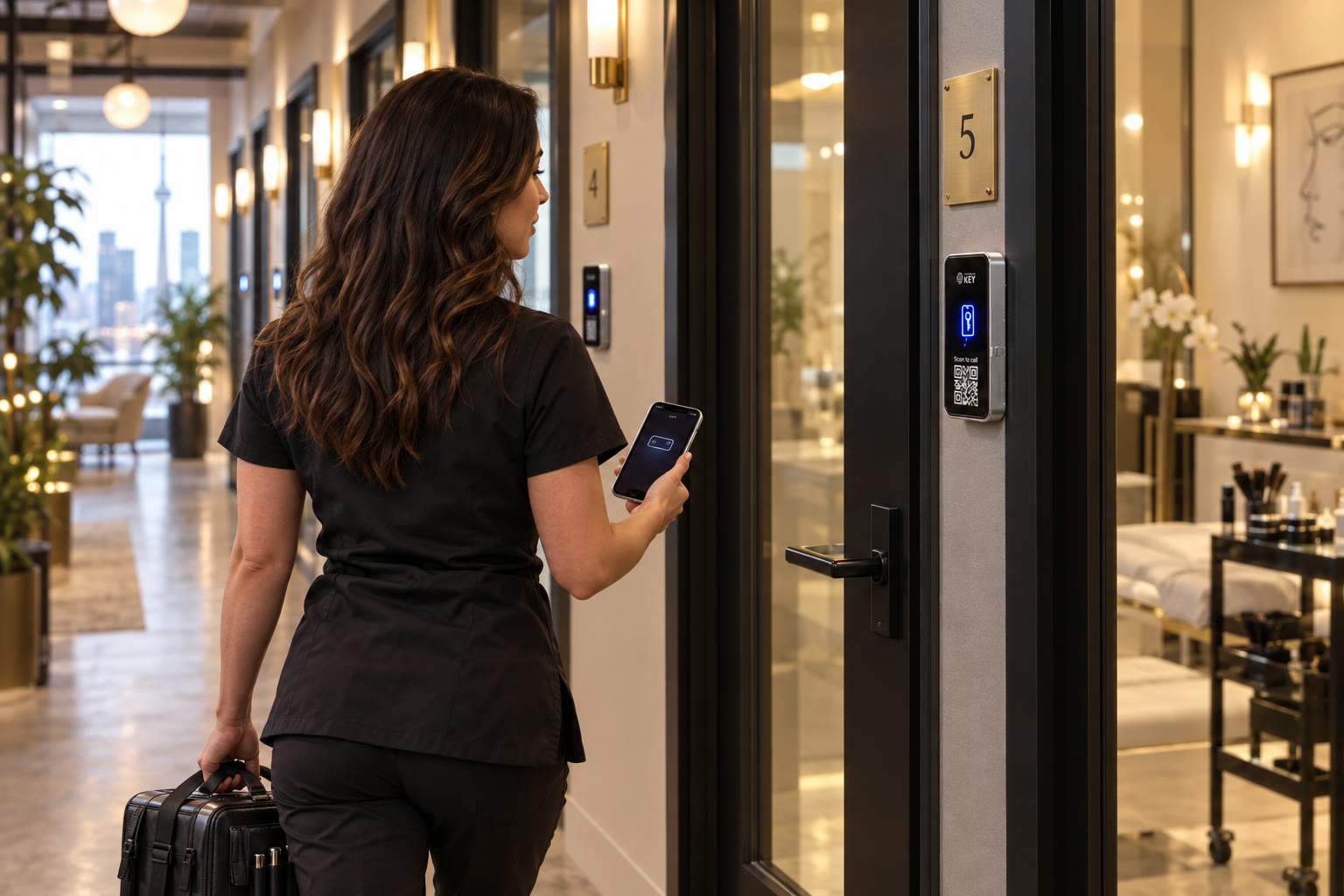
Salon suites and rental rooms · Toronto & GTA
Shared reception. Separate working spaces.
Give the common entrance and each rented room their own place in the access plan. A practitioner should be able to reach an authorized suite without receiving unnecessary permission elsewhere.
Room and common-route planning
Identify the rooms and the party managing the premises.
Identify common entrances, assigned suites and who authorizes changes. Assess the physical doors before committing to equipment.
Describe the rental operation
Identify room assignments and the operator maintaining them.
Check shared-door dependencies
Assess each selected lock and connection requirement.
Agree turnover controls
Review booking changes, credential withdrawal and operator costs.
In short
How should access work in a building of rented rooms?
Separate the owner's responsibilities from each renter's
Treat the common entrance and private rooms as distinct permissions. SmartphoneKey supports credentials associated with authorized locks and time-limited guest access. The premises owner must still decide who may grant room access and how changes in renter agreements reach the administrator. Automatic synchronization with room-booking or rental-payment software is unconfirmed.
Example, not a completed project
One room changes hands while its neighbour stays occupied.
Consider an illustrative premises where a renter leaves one suite while another practitioner continues seeing clients next door. Management needs the departing renter's room and shared-entry permissions reviewed, the incoming person's approved route explained and existing occupants told about any installation work affecting the approach. A new credential alone is not the whole room handback. The administrator needs an authorized decision about old access, temporary users and the start of the new arrangement. A client visiting the neighbouring room may still need a host or calling route even though the common door is shared. This example is a planning exercise, not a completed site or evidence that a rental platform performs the changes automatically.
Shared premises, different responsibilities
Plan the operator's route and the renter's authorized room.
The premises operator manages the common approach and access process. Each renter has an approved use of a particular space. Put both perspectives into the proposal without granting a building-wide permission for convenience.
What the premises operator needs to define
- Keep a named opening list for the front door, common route and rooms in the proposed phase. Record who can approve alterations and which existing locks or releases will be assessed for retention. This makes the equipment scope understandable without assuming every neighbouring room is included.
- Identify the person authorizing a renter's access and the administrator applying that decision. They need a way to learn about an ended agreement, changed hours or lost credential. An updated rental document does not establish that somebody has already changed the door permissions.
- Explain the shared client-arrival arrangement: where a visitor waits, who receives a call and what happens if the intended practitioner is unavailable. A calling feature does not provide staffed reception. Avoid solving a missing host by handing every client an unrestricted premises credential.
- Agree how installation access and any interruption are coordinated across occupied rooms. Identify the relevant service areas and affected finishes with the installer. The proposal should distinguish the physical work, ongoing connection or package charges and the operating handover to management.
What the renter needs to understand
- Specify the common openings and assigned room the renter may use. Explain which nearby rooms or management areas are outside that permission. One credential can be part of an agreed multi-door arrangement without meaning the holder is entitled to enter all connected spaces.
- For an hourly room use or visiting practitioner, agree the actual purpose and period before choosing guest limits. Identify who issues the permission and handles a moved appointment. A time-bounded credential does not establish automatic creation or adjustment from an external booking calendar.
- Discuss cleaners and maintenance by the room or shared area they are approved to reach. A premises-wide service arrangement and work requested by an individual renter can have different authorizers. Keep those permissions separate from a permanent practitioner credential used as a convenient workaround.
- At a room handback, include the renter's ongoing and temporary permissions in the review. The next user needs arrival instructions and the relevant assistance contact, while management retains the accepted equipment and administration record. A changed room label is not proof that access has been transferred correctly.
Work from the room arrangement
A room assignment is more specific than a building key.
Long-term suite rental, a visiting practitioner and an hourly room booking produce different access requirements. Do not solve all three with one permanent credential.
01Define the common route
Identify the street entrance, shared corridor and assigned suite. Check which openings can be assessed for a reader and powered lock. A renter may need the first two doors without being entitled to enter neighbouring rooms or management storage.
02Match permission to the agreement
Record who rents each space, their approved hours and who can authorize a visitor. A short room arrangement may call for a limited window; a regular practitioner may need a different routine. The access administrator needs to make those changes explicitly.
03Handle the change of occupant
Decide how a room handback, cancelled session or departing renter is reported. Withdraw old permission before treating a new credential as the whole handover. Include any shared cards or temporary permissions in that review.
The product materials describe authorized locks, credentials and limited guest permissions. Room assignment, renter approval and client arrival are operating decisions for the premises; automatic changes from a booking or rental-payment platform have not been verified.


Work from the room plan
Trace the shared approach and each proposed private opening.
Show the assessor the entrance, corridor and rooms being considered. Identify which party controls the hardware at each opening and any work through occupied or finished areas. Ask which releases can remain and what power, reader and cabling each connected door requires. The number of renters does not establish the number of suitable locks. Keep a room outside the proposed phase explicit so a common-front-door project is not mistaken for a complete conversion of the premises.
Is it the right fit?
Can the room boundaries be maintained after handover?
Approval and administration are assigned
- Common and private doors can be listed separately.
- The operator can maintain renter-specific permissions.
- Access changes can be tied to an agreed room-use process.
Clarify the room or booking dependency
- You need confirmed automatic booking or payment integration.
- A renter wants to alter common hardware without the operator's consent.
Practical room-access questions
Make the shared route as clear as the private room.
A renter, visitor and premises operator may reach different points beyond the same entrance. Explain who approves each permission and who handles a changed booking or room assignment.
Can one key cover the entrance and one suite?
The documentation supports access associated with several locks. The actual assignment should include only authorized doors. Confirm the assessed hardware and which person is allowed to grant each part of that route.
Does an hourly booking create its own key?
That automation is not established. A manager can plan a guest access window, but booking software does not become connected merely because a time-limited credential exists. Keep the manual process clear until a specific integration is proven.
How do clients reach a practitioner?
Consider the visitor route and who will respond at the premises. SmartphoneKey describes QR visitor calling, but the intended recipient and instructions still need to fit the operator's arrangement. A client should not be given another renter's key by default.
What about shared cleaners or maintenance?
List the authorized rooms and work times rather than using a permanent master credential for convenience. Agree who cancels permission if a visit changes. Keep the person administering access accountable to the premises operator.
Will room doors need new locking hardware?
Possibly. The reader controls suitable electric locking hardware; it does not establish that every existing suite lock can be reused. Include each proposed room door in the assessment before budgeting for several readers.
What should be reviewed when a room is handed back?
Identify the openings the departing renter could use, any temporary permissions they arranged and the party responsible for approving the change. Have the administrator apply and review the intended withdrawal before treating a new credential as a complete handover. The incoming renter then needs their own agreed route and arrival instructions. A room agreement ending or a physical card being returned does not by itself establish the state of every access permission.
Can a front-entrance project leave individual room doors for later?
The proposed phase should state which openings are included and which remain outside the work. A shared-entrance reader does not establish that private-room locks have been assessed or converted. Explain what the initial arrangement will and will not control so renters understand the boundary. Later room work still needs the relevant approval, physical assessment and a decision about which users should reach that space.
How should we plan for a client who cannot use the expected arrival method?
Agree an actual assistance route with the premises operator and practitioner. Explain where the client should wait and who can decide on admission. QR calling or an expected guest credential is not a universal solution for every visitor, and a staffed response should not be inferred from the presence of a reader. Include that practical question in the operating handover rather than leaving it to a first appointment.
Next step
Start with the room list and its rules.
Identify common entrances, assigned suites and who authorizes changes. Assess the physical doors before committing to equipment.
Request a door checkAsk for a proposal tied to the room list
Identify retained equipment, releases and readers for the common entrance and each room in scope. Include supply and cable routes, affected finishes, credential administration and continuing charges. Mark any required booking integration or later room phase separately so the operator and renters understand the arrangement being proposed now.
For a Toronto or GTA premises assessment, coordinate the contact able to open the shared and private areas included. Explain occupied appointment periods and the parties who approve work through finished rooms. Installation timing and temporary arrival instructions depend on the inspected scope; this preview does not reserve a work date or send a client invitation.