
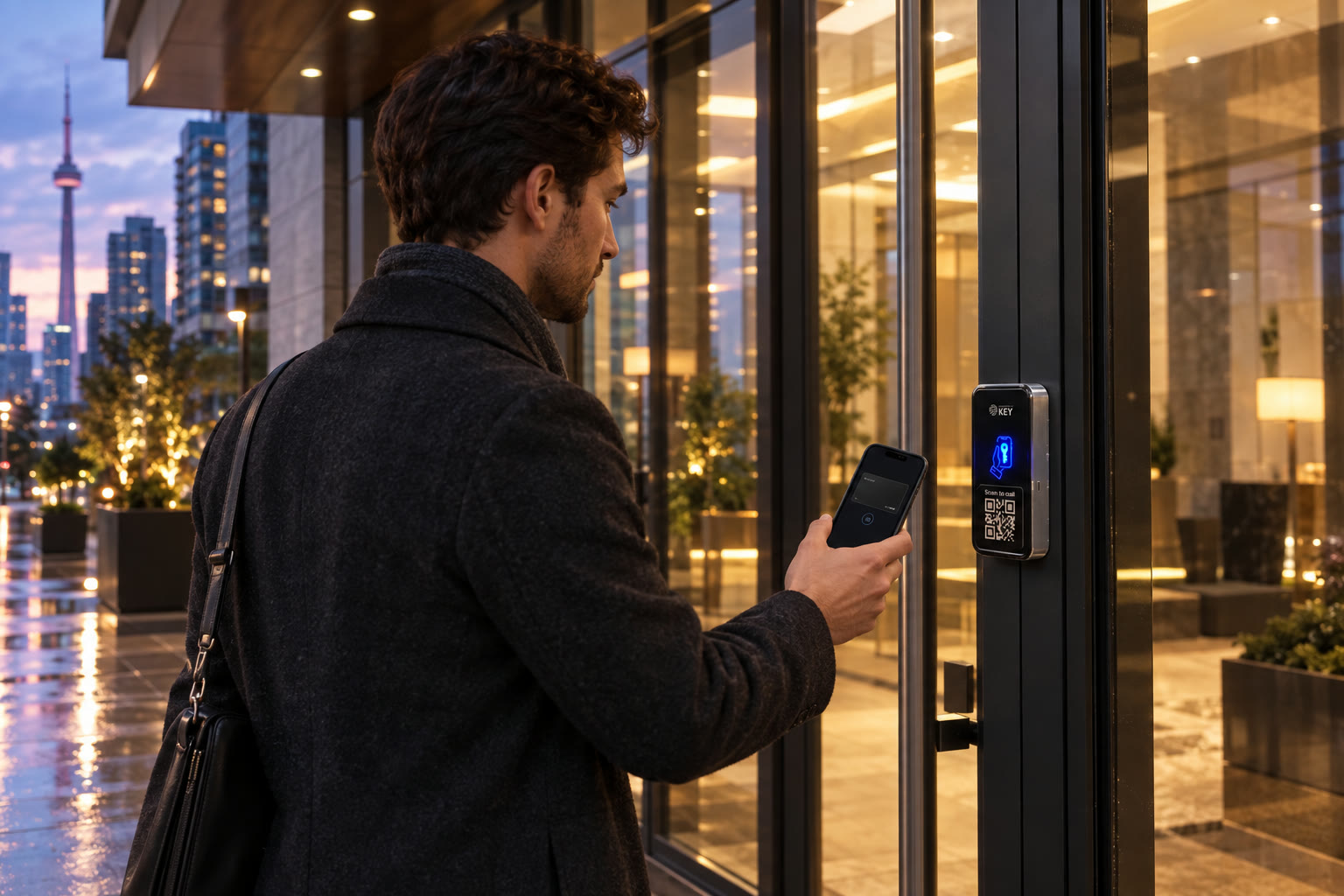
Shared residential entrances · Toronto & GTA
One lobby. Many separate households.
Choosing an apartment intercom system affects residents, managers and people arriving at the building for the first time. Start with responsibility for the shared entrance and the practical needs of each household.
Prepare the shared-lobby discussion
How should residents, guests and management use the entrance?
Bring the current lobby arrangement and resident needs to management. An assessed proposal gives everyone a concrete change to consider.
Define the resident process
Identify directory ownership and the building approval contact.
Assess the common entry
Review visitor routing and resident credential needs together.
Confirm management handover
Include moves, alternative arrivals and the installation proposal.
In short
What makes a lobby project different from a private door?
A decision for building management and the responsible owner
The shared entrance serves people who have not chosen the same phone or arrival routine. A lobby proposal must consider regular resident credentials, visitor communication and administration when occupants change. SmartphoneKey combines documented Wallet and NFC-card access with QR visitor calls, but the building must establish whether that arrangement fits its entrance and residents.
Example, not a completed project
One household moves out while another receives its instructions.
Imagine a building preparing a new household's lobby access while an earlier occupant is leaving. Issuing the incoming credentials and reviewing the outgoing permissions are separate jobs that must reach the assigned administrator. Neither should depend solely on collecting an old physical card. Management also needs to explain the supported credential choices and visitor calling arrangement to the incoming household. This is an illustrative changeover, not a record of a tenant, an automatic property-management connection or a statement that a common-door key authorizes entry to a private unit.
A lobby decision has several responsible parties
Compare the resident transition with the continuing management job.
The project should say which common openings change and who maintains the resulting arrangement. Review the experience for households as well as the administrative capabilities offered by the equipment.
Explain the change to households
- Describe which entrance is affected and which private doors or separate systems remain outside the proposal. Shared-lobby permission has a defined purpose; it should not be presented as authority over another household. Keep the approving property party involved when the route crosses common and privately controlled openings.
- Discuss the supported phone and NFC-card options without assuming that every household uses the same device or wants the same daily method. Establish how instructions and assistance will be arranged. Compatibility with old fobs or indoor equipment requires specific confirmation, even when both systems appear to perform a familiar entry function.
- Review the visitor experience from outside the building with the intended recipients. Explain how an expected guest finds the reader and reaches the appropriate person, then address an unavailable recipient or guest unable to follow the usual phone interaction. Do not substitute a general calling feature for an agreed building response process.
Keep the arrangement current after changeover
- Name who receives authorized occupancy updates and who changes the door permissions. Include departures and changes within a household, rather than treating initial enrollment as the whole management process. The documented portal does not establish that a tenancy record updates access automatically.
- Distinguish a lost credential from a returned object and explain how management reviews its permission. A key being physically handed back does not, by itself, demonstrate the state of every associated authorization. Practise the intended administrative operation using an agreed example at handover.
- Retain the assessed opening list, equipment boundaries, support contacts, administrator responsibilities and continuing costs for future management. Explain what was demonstrated and what remains unresolved. A successful entry by one resident does not prove that every household, guest route and occupancy-change routine has been addressed.
Build the management brief
Keep household boundaries clear.
A resident may need to admit a guest without managing another household. Plan responsibilities before changing how the lobby operates.
Authority over the common entrance
A unit resident cannot assume permission to alter shared locking hardware. Identify management, the responsible owner or the condominium decision-maker before equipment is selected. Document which doors belong to this project and which private-unit doors are outside it.
A credential plan residents can use
Some people will prefer phone keys; others may need a product-specific NFC card. Include moves, lost credentials and access for authorized household members in the operating process. Do not require a shared permanent credential merely because several occupants live together.
A visitor plan residents understand
Explain the documented QR calling route and establish how visitors find their intended recipient. Ask management to consider residents or guests who cannot use the expected phone interaction. A change should be evaluated from the lobby side as well as the administrator portal.
A manageable changeover
Agree how current entry remains available during the work and who answers resident questions afterward. Walk through move-in and move-out administration, an absent recipient and the building-specific fallback. None of those arrangements is established simply by buying a reader.
The product materials establish Wallet credentials, NFC cards, QR visitor calling and administration functions. The household boundaries and occupancy-change examples here are management planning questions, not evidence of automatic tenancy synchronization, resident consultation or approval of a particular lobby conversion.


Review the common entrance with management
Assess the lobby as a shared operating arrangement.
Include the responsible management contact and the person familiar with existing door equipment. Show the resident and visitor routes, current panel or handset arrangements and the common-door release. Ask which equipment the proposal would retain and how residents would learn the change. Households may prefer different supported credentials and need different assistance. Review move-in, move-out and an unavailable recipient as operating cases; fitting a reader does not by itself settle the building's approvals or ongoing responsibilities.
Is it the right fit?
Can management own the resident transition and later changes?
Shared-door responsibility is established
- Management is involved in assessing the common entrance.
- Resident credentials and visitor handling can be planned together.
- A named administrator will maintain changes to occupancy.
Approval or household support needs clarification
- One tenant wants to replace common equipment without approval.
- You need unverified compatibility with every apartment handset.
Questions for the building's operating plan
Keep shared entry distinct from each household's decisions.
Management needs a proposal residents can understand and an access list it can maintain. Explain both the new arrival method and the process that keeps permissions appropriate as occupancy changes.
Can residents keep their current fobs?
Do not promise that before the existing system is reviewed. SmartphoneKey documents its own NFC cards. Retaining a separate fob arrangement, replacing it or operating equipment together requires a specific assessment.
Does a resident key open other units?
The proposed permission plan should limit each user to authorized doors. A shared-lobby credential is not a reason to grant access to another household. Define the lock groups and administrators before issuing keys.
Who removes access after a move?
The building needs an assigned administrator and a reliable notification process. Portal revocation is a capability; the product does not automatically know that a tenancy or occupancy has ended.
Can a unit owner decide for the whole building?
Common entrances have their own approval arrangements. Discuss the proposal with the responsible management or condominium decision-maker. Ownership of one unit does not by itself establish authority to change the lobby.
What should residents be told about records?
Explain which entry information administrators can see and why it is used. Keep camera access and administration roles deliberate. The installer should not imply that an access event proves where someone spent the rest of the day.
Does collecting an old fob complete a move-out access change?
Collecting the object and reviewing its authorization are different actions. Management should make sure the relevant instruction reaches the person maintaining permissions. The product can support revocation, but this page does not establish that a move-out or returned card automatically triggers it. Include the intended process in the operating handover without sending a private tenancy record through this preview.
Should private-unit doors automatically join a lobby project?
No such inclusion should be assumed. Identify the common openings actually proposed and the authority responsible for each. A private door may have another owner, lock arrangement and permission plan. Keep it outside the claimed scope unless its involvement has been explicitly assessed and authorized; a shared-lobby credential alone does not settle that question.
How can a building compare the change without publishing resident details?
Begin with the equipment inventory, approximate credential groups, ordinary visitor situations and management responsibilities. Describe an illustrative household move and an unanswered guest arrival rather than uploading a resident directory. The proposal can establish hardware and operating questions before detailed credential enrollment or recipient arrangements are agreed.
Next step
Start with the building conversation.
Bring the current lobby arrangement and resident needs to management. An assessed proposal gives everyone a concrete change to consider.
Request a door checkRequest the common-door scope and resident changeover together
List the shared openings, retained release and answering equipment, proposed reader connection and any physical work. Include resident credential choices, visitor instructions, management handover and continuing package charges. Keep unconfirmed fob or handset reuse visible as a separate question rather than an implied feature of the conversion.
For the Toronto/GTA building discussion, coordinate management and maintenance access to the lobby and relevant equipment. Identify the approving party and how households would receive agreed instructions after assessment. This local preview reserves no installation window and sends no resident announcement.